
⭐ Intro: Why This Matters for Schools Today
Agentic AI — systems that can autonomously plan, execute, and complete multi‑step tasks — is rapidly reshaping higher education. Universities are already confronting the reality that students can use AI agents to navigate LMS platforms, complete assignments, and generate polished submissions with minimal human input.
But the real question for K–12 schools is this: How do we prepare children now so they can thrive in a university landscape transformed by agentic AI?
This curated summary highlights the article’s key insights and translates them into actionable recommendations for primary and secondary schools.
🧭 What the Original Article Says (Curated Summary)
The article outlines how agentic AI tools — such as Claude’s “Coworker” mode, ChatGPT’s “Atlas,” and Perplexity’s “Computer Use” — are becoming capable of:
autonomously navigating learning platforms
completing multi‑step academic tasks
generating files, reports, and submissions
integrating research, writing, and formatting
performing actions that previously required human judgment
Because of this, universities are shifting away from traditional assessments and toward formats that emphasize:
oral defenses
iterative drafts
personal reflection
in‑class demonstrations
authentic, context‑bound tasks
The message is clear: AI is now infrastructure, not a novelty. Higher education must adapt — and so must schools.
🎒 What K–12 Schools Should Do Now
Although the article focuses on universities, the implications reach deep into K–12. If universities expect students to demonstrate thinking, reflection, and authentic engagement, then schools must begin cultivating these competencies early.
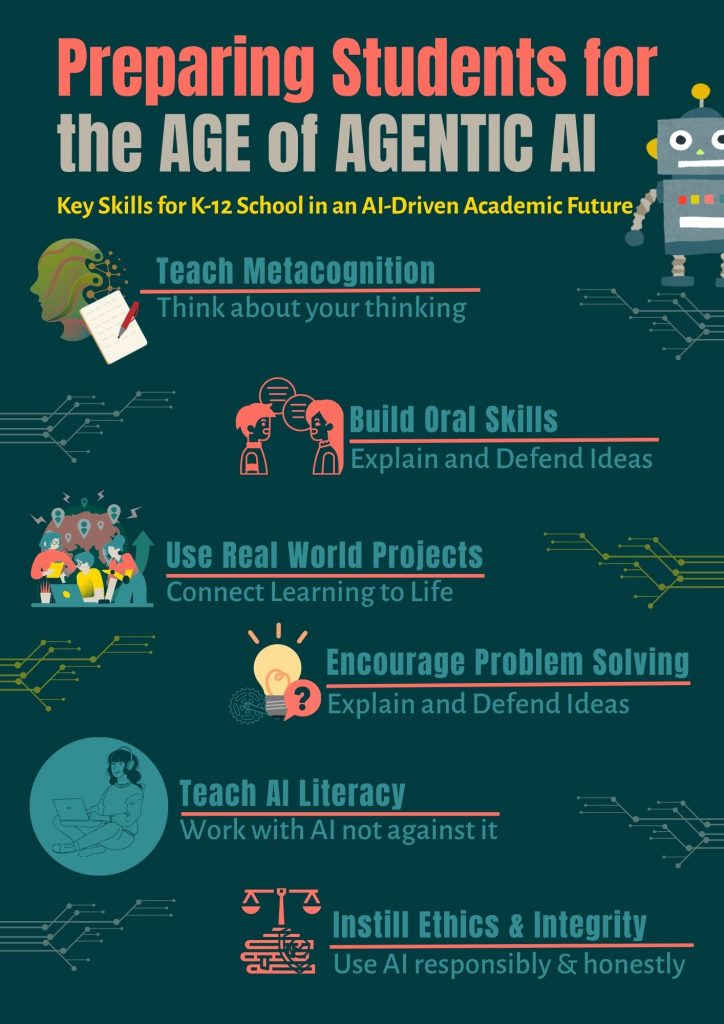
Below are the six most important areas where schools can act now.
🧠 1. Teach Metacognition Early
Universities increasingly assess how students think, not just what they produce.
K–12 strategies:
learning journals
reflection prompts (“What was your strategy?”)
documenting drafts and revisions
peer feedback cycles
think‑aloud routines
Why it matters: Students must be able to show their thinking — something AI cannot do for them.
🗣️ 2. Strengthen Oral Communication Across Subjects
Oral defenses are becoming a cornerstone of university assessment.
K–12 strategies:
short oral explanations of work
micro‑presentations
debates and structured discussions
spontaneous “explain your reasoning” tasks
Why it matters: Speaking reveals understanding in ways AI cannot replicate.
🔍 3. Use Authentic, Local, and Personal Tasks
Universities are moving toward tasks grounded in personal experience or local context.
K–12 strategies:
projects tied to the school, community, or real data
assignments requiring personal perspective
interviews, observations, and fieldwork
Why it matters: AI can generate generic answers — but not lived experience.
🧩 4. Emphasize Open‑Ended Problem Solving
Agentic AI excels at structured tasks but struggles with ambiguity.
K–12 strategies:
open‑ended questions
multi‑path projects
“How would you approach this?” scenarios
inquiry‑based learning
Why it matters: Universities will expect students to navigate uncertainty, not just follow instructions.
🛠️ 5. Teach AI Literacy as a Core Competency
The article makes it clear: banning AI is futile. Universities are integrating it.
K–12 strategies:
using AI for brainstorming, research, and feedback
analyzing AI outputs for accuracy and bias
comparing human vs. AI strengths
experimenting with simple agent workflows
Why it matters: Students must learn to collaborate with AI, not hide from it.
🧭 6. Build Ethical Awareness and Academic Integrity
Agentic AI makes cheating easy — integrity must be taught, not assumed.
K–12 strategies:
transparency rules for AI use
discussions about authorship and responsibility
case studies of ethical vs. unethical AI use
reflection on the purpose of learning
Why it matters: Universities will expect students to navigate AI ethically and responsibly.
🏫 Practical Recommendations for Schools (K–12)
✔️ Curriculum
Integrate AI literacy across subjects
Prioritize process over product
Include oral, reflective, and authentic tasks in every unit
✔️ Assessment
Multi‑step assignments with drafts
Oral checkpoints
Portfolios instead of one‑off submissions
Tasks tied to personal or local context
✔️ School Culture
Clear AI guidelines for students
Teacher training on agentic AI
A culture of transparency and reflection
📌 Key Takeaway
Agentic AI is transforming higher education — and K–12 schools must prepare students now. The future belongs to learners who can think, explain, reflect, and collaborate with AI. Those skills start long before university.