Some ideas do not begin with strategy papers or formal concepts. Sometimes they start with a simple observation. During a leadership discussion at the German International School in Ho Chi Minh City we noticed something that is almost obvious: children often learn in the same way researchers work.
They ask questions. – They search for information. – They test ideas. – They observe results. – And they discuss their findings with others.
In other words: learning often follows a research logic.
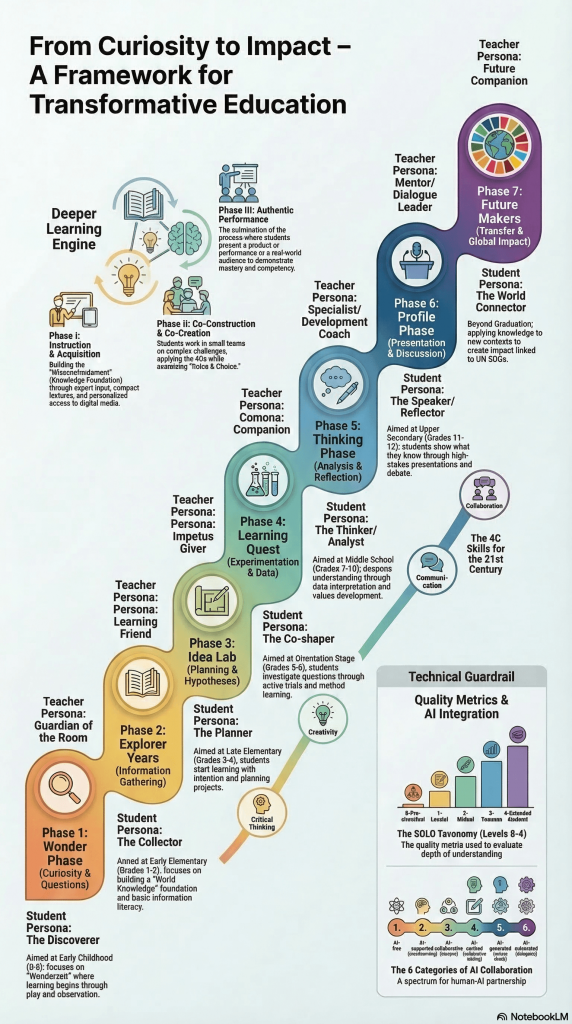
From this observation I sketched a simple structure that I called the research phases of learning:
- Curiosity and questions
- Gathering information
- Forming hypotheses
- Experimentation
- Analysis
- Presentation and discussion
- Transfer and application
At first it was only an idea. But it stayed with me.
For more than fifteen years I have worked in different roles across the education sector – both in schools and in higher education.
This experience allows me to look at learning not only from a pedagogical perspective but also from a strategic and organizational one. After that initial conversation I started exploring the idea further: reading studies, comparing international learning models and gradually refining the framework.
One question kept returning: What capabilities do young people actually need in a world that is constantly changing?
Global discussions about future skills often point to the same themes:
critical thinking, problem solving, creativity, collaboration and the ability to keep learning.
The more I explored these questions, the clearer one insight became: Perhaps the most important competence of the future is the ability to learn again and again. This insight also highlights something else: foundational skills matter more than ever.
Reading. Writing. Numeracy.
These are the tools that allow people to access knowledge throughout their lives.
Within this perspective the research phases become a framework on which such capabilities can grow. A model like this does not only change the learning of students. It also transforms the role of teachers. In traditional classrooms teachers often stand at the center of knowledge. In inquiry‑based learning environments their role shifts.
Teachers increasingly become designers of learning processes. They frame questions, guide projects, facilitate discussion and support reflection.
In short: they become architects of learning.
While developing the framework further, I encountered several international educational approaches with similar ideas – including the concept of Deeper Learning, which emphasizes understanding, application and reflection rather than memorization alone.
At the same time I continued working with impact‑oriented thinking in social systems. In this context the United Nations Sustainable Development Goals provide an interesting perspective, as they connect learning, innovation and societal impact. Out of this reflection a simple formula emerged:
Curiosity → Inquiry → Understanding → Application → Impact.
Or simply: From Curiosity to Impact.