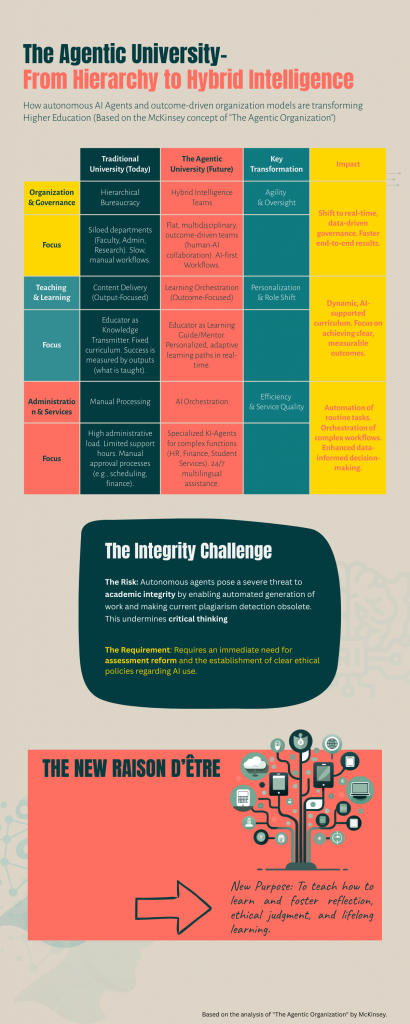
Universities remain among the last institutions structured around strong hierarchies. At the same time, recent thinking on the agentic organisation points toward flatter, outcome-driven teams in which humans and AI agents collaborate dynamically rather than through rigid reporting lines.
This raises an interesting question for higher education: what would happen if universities adopted a more agentic model?
In such a scenario, research, teaching and administration would be driven by cross-functional teams supported by specialised AI agents. Decision-making would rely more on real-time data and less on sequential approval processes. Governance would shift from controlling inputs to steering outcomes, with human oversight remaining central.
The implications for teaching are equally significant. If AI systems increasingly personalise learning pathways, the role of educators moves from knowledge transmission toward learning design, guidance and critical reflection. Outcomes matter more than outputs, and curricula become more adaptive, interdisciplinary and learner-centred.
Administrative functions could evolve from processing units into orchestration hubs. AI agents might manage end-to-end workflows, provide multilingual student support around the clock, and generate actionable insights across finance, admissions and quality assurance. Efficiency would be only a baseline benefit; the real shift would be towards intelligence by design.
However, increased autonomy also brings risk. Academic integrity, fairness and critical thinking cannot be delegated to autonomous systems. Assessment models, ethical frameworks and governance boundaries would need to be redefined carefully to ensure that automation strengthens, rather than undermines, academic values.
If knowledge is ubiquitous, the university’s role inevitably changes. It moves from being a gatekeeper of information to becoming an adaptive learning ecosystem—one that cultivates judgment, ethical reasoning and the capacity for lifelong learning. In a world where AI already “knows,” the core mission becomes teaching people how to learn, how to question and how to decide responsibly.
The open question remains: would an agentic university become more human—or less?